
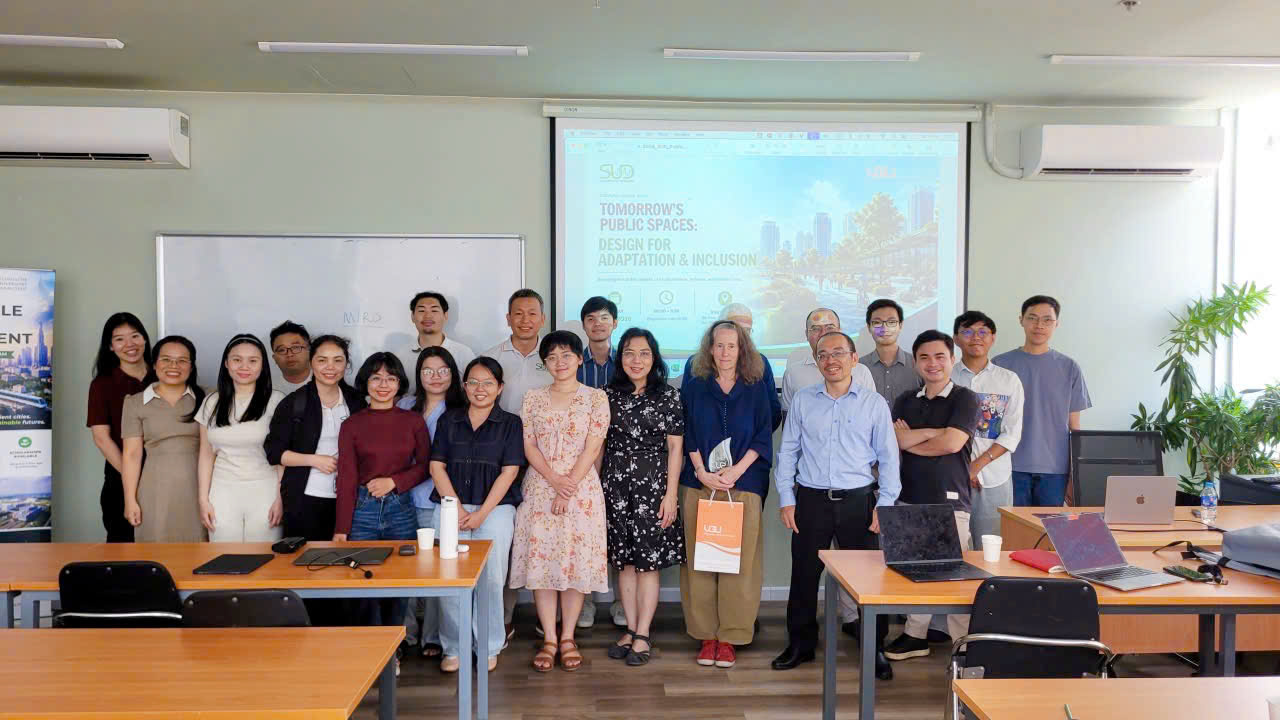
The event brought together academics, researchers, urban practitioners, and students to discuss how public spaces can respond to contemporary urban challenges including climate change, rapid urbanization, social inequality, and evolving patterns of everyday urban life.
The program featured three keynote presentations.
Presentations
In the first lecture, Dr. Pham Thai Son introduced the APST (Activity–People–Space–Time) Framework as an evidence-based methodology for studying and designing public spaces. Through multiple student research examples from Vietnam, participants learned how behavioral mapping and systematic observation can generate data-driven planning and design solutions
The second keynote, delivered by Prof. Kelly Shannon, “Learning from the Everyday Public Realm,” emphasizing the importance of understanding everyday spatial appropriation in Ho Chi Minh City and other Southeast Asian contexts. Her presentation highlighted the city’s limited green space provision and the need to integrate ecological infrastructure with everyday urban practices.
In the third lecture, Prof. Bruno De Meulder presented “Exemplary Public Space Upgrades for Global Warming & Inclusion,” introduced international planning and design strategies from Paris and other cities, showcasing how regional green systems, street redesign, and school-centered public spaces can support socio-ecological resilience and social inclusion.
The event concluded with an interactive session where participants applied the APST framework to analyze public spaces and discuss opportunities for adaptive and inclusive urban design.
The SUD Program extends its sincere appreciation to all speakers, participants, and organizers for contributing to a highly engaging and meaningful academic exchange.