
Workshop “Creating Community Play Spaces”: When Playgrounds Become Part of a Livable City
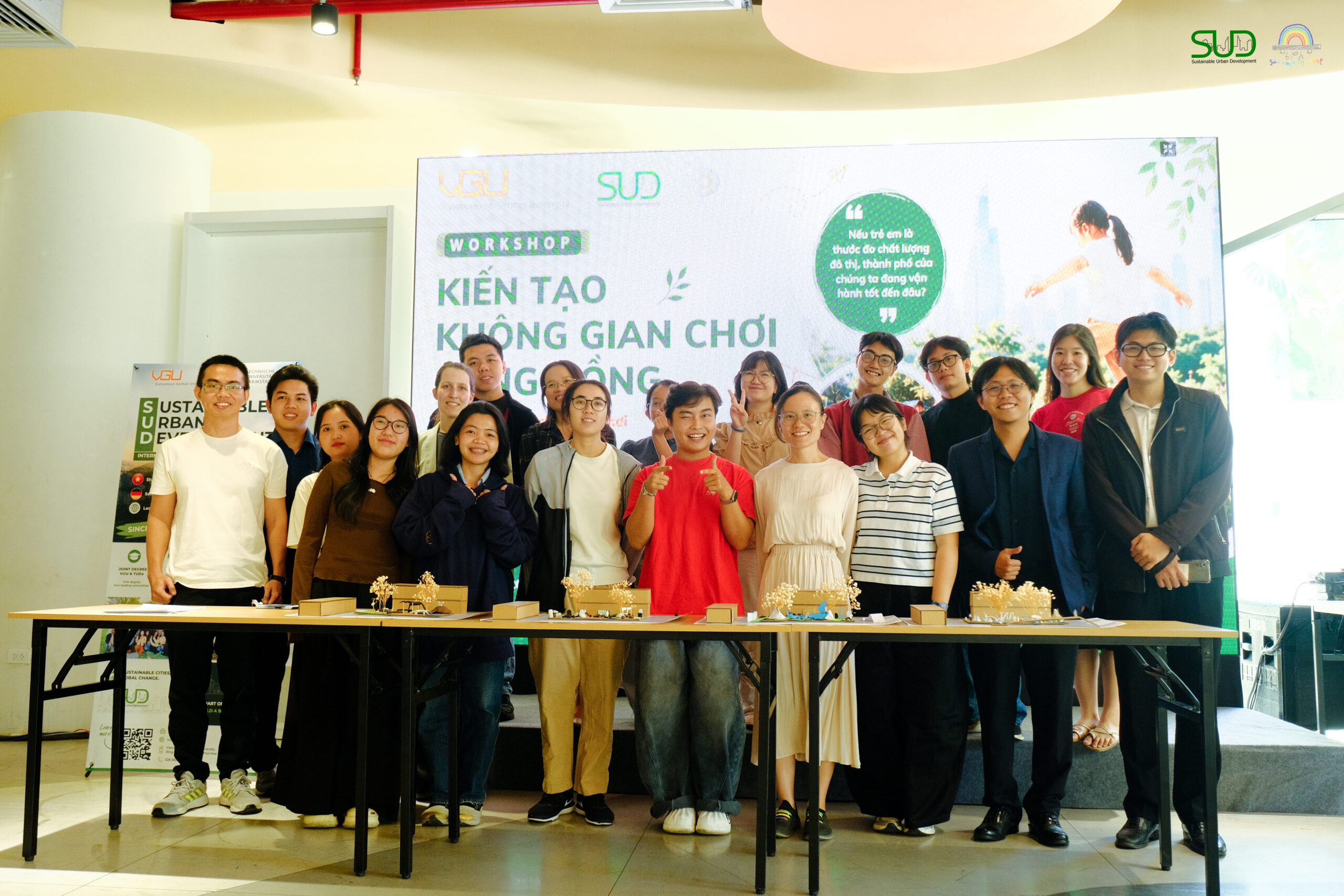
On June 20, 2026, the Sustainable Urban Development (SUD) Program at the Vietnamese-German University (VGU), in collaboration with the Rainbow Playground Project (Sân Chơi Cầu Vồng), organized the workshop “Creating Community Play Spaces – A Playground is More Than Just a Place to Play” at SIHUB, Ho Chi Minh City.
Bringing together students, researchers, practitioners, educators, and community members, the workshop provided a platform to discuss the role of play in children’s development and the importance of creating child-friendly public spaces in rapidly urbanizing cities.
The workshop opened with a presentation by Dr. Dao Thi Bich Van, Lecturer of the Sustainable Urban Development Program, who invited participants to reflect on a fundamental question:
“If children are a measure of urban quality, how well is our city performing?”
Drawing on international research on child-friendly cities, public space, and children’s right to play, Dr. Van highlighted how children are often the first group to experience the shortcomings of urban environments, including the lack of green spaces, unsafe mobility conditions, and limited opportunities for independent play. At the same time, she emphasized that cities designed to meet children’s needs are often healthier, safer, and more inclusive for all residents.
A key component of the presentation was the introduction of the SPACES Framework, developed by WHO, UNICEF, and UN-Habitat. The framework evaluates play environments through six dimensions: Safety, Play, Access, Child Health, Equity, and Sustainability, offering a practical tool for assessing and designing child-friendly public spaces.
The second session featured Mr. Nguyen Thanh Phong, representative of the Rainbow Playground Project and a student of the Sustainable Urban Development Program. Through stories and examples from community playground initiatives across Vietnam, participants learned how underutilized spaces can be transformed into meaningful play environments through local participation, creativity, and collective action.
The workshop concluded with a hands-on design session facilitated by Ms. Nguyen Tran Khanh Ngoc, former Creative Director of Arkki Vietnam. Using the SPACES framework as a guiding tool, participants worked in groups to conceptualize and build playground models that prioritized safety, inclusiveness, accessibility, and sustainability. The activity encouraged participants to view the city from a child’s perspective and explore how public spaces can better respond to the needs of younger generations.
By combining academic insights, practical experiences, and participatory activities, the workshop offered a holistic perspective on the role of play in sustainable urban development. More than recreational facilities, playgrounds were discussed as a form of social infrastructure that contributes to children’s well-being, community cohesion, and overall urban quality.
As cities continue to grow and urban pressures intensify, creating child-friendly environments requires the collective efforts of planners, designers, educators, policymakers, and local communities. After all, a city that works for children is ultimately a city that works better for everyone.